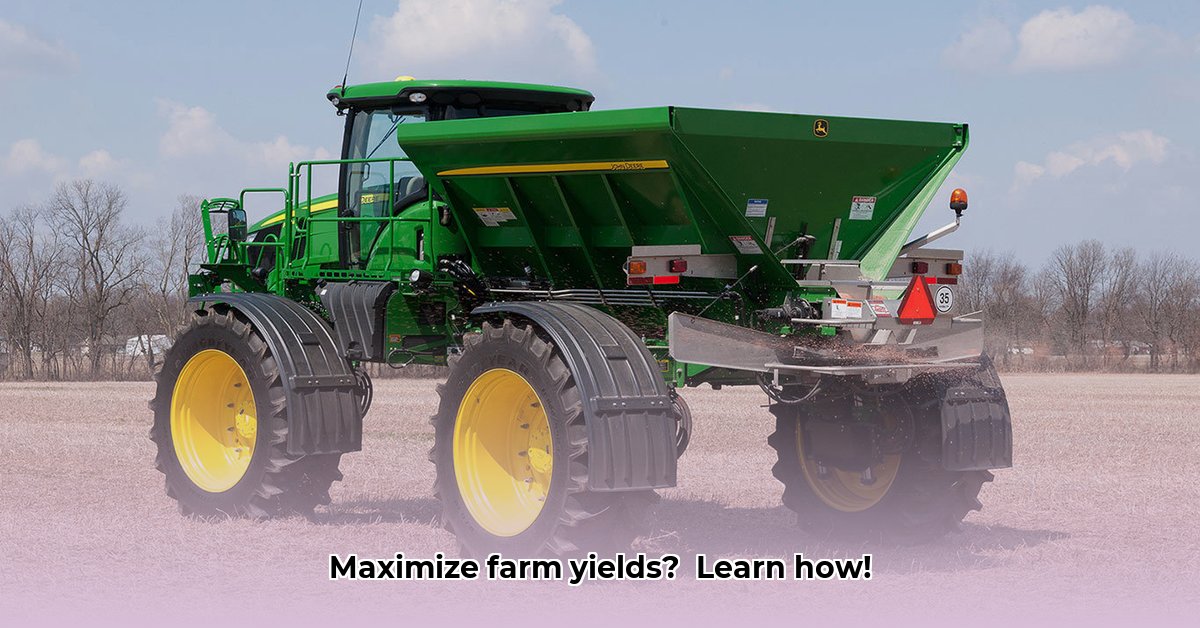
Choosing the Right Fertilizer Spreader for Your Farm
Selecting the appropriate 3-point PTO fertilizer spreader is crucial for efficient and sustainable farming. This decision hinges on several key factors, aligning your spreader's capabilities with your farm's specific needs and operational scale. Failing to select the right tool can lead to inefficiencies and environmental concerns.
For more information on tractor fuel efficiency, check out this helpful resource: fuel efficiency guide.
How much fertilizer do you typically apply? Larger spreaders are ideal for expansive fields and high application rates, while smaller models suit smaller farms or specialized applications. Consider your average annual fertilizer usage to determine the appropriate hopper capacity. Spreaders range from 200 lbs to over 800 lbs, each with its own optimal application range.
What type of fertilizer do you use? Granular fertilizers are common, but some spreaders are designed for other fertilizers, such as liquid or pelletized options. The spreader's design must match the characteristics of your chosen fertilizer – granular spreaders, for instance, have different mechanisms than those handling liquids. Check the manufacturer's specifications to ensure compatibility.
What's your field's width and terrain? A wider spread width implies fewer passes, saving you time and fuel. However, uneven terrain might demand a more robust spreader capable of handling bumps and slopes. Precise spreading is crucial for uniform plant growth. Assess your fields and choose a spreader with appropriate ground clearance and drive mechanism.
What's your budget? Spreaders vary widely in price, influenced by features like hopper capacity, spread width, and construction materials. Balance your budget constraints with your farm's needs, seeking a high-quality option within your financial reach. A well-maintained, appropriately sized spreader is a long-term investment in efficiency and profitability.
Understanding 3-Point Hitch Fertilizer Spreaders
3-point hitch fertilizer spreaders are a popular choice amongst farmers. Their versatility, ease of attachment to tractors, and degree of control make them efficient and effective. Power is drawn directly from your tractor's PTO (power take-off), eliminating the need for a separate engine, leading to significant fuel efficiency. This direct power transfer ensures consistent fertilizer distribution and application rates, reducing labor costs and improving application accuracy. However, proper calibration and maintenance are paramount for optimal performance and longevity.
Don't underestimate the importance of calibration. Applying too much or too little fertilizer can lead directly to reduced yields, environmental damage from runoff, and wasted resources. Regular calibration ensures accurate fertilizer distribution.
Calibrating and Maintaining Your Spreader: A Step-by-Step Guide
Consistent calibration is core to responsible fertilizer management. Inaccurate application wastes resources and can harm the environment. Regular maintenance ensures that this precision instrument works consistently over the long term.
Calibration:
- Measure Output: Collect the fertilizer dispensed over a known distance using a container of precise volume.
- Adjust Settings: Based on the measured output, adjust the spreader's settings (often found on a control panel) to match your desired application rate. Consult your spreader's manual to understand the specific adjustment mechanisms.
- Verify Accuracy: Repeat the measurement to confirm that your adjustments resulted in the correct application rate. Repeat this process as needed to fine-tune the settings for optimal performance.
Maintenance:
- Lubricate Moving Parts: Regularly lubricate all moving parts according to the manufacturer's recommendations. This prevents wear and tear, ensuring smooth operation.
- Clean Thoroughly: Clean the spreader after each use to remove any residual fertilizer, preventing clogging and corrosion.
- Inspect for Wear: Regularly inspect the spreader for signs of wear and tear, replacing worn or damaged components promptly. This proactive approach prevents breakdowns and costly repairs.
Sustainable Farming with Fertilizer Spreaders
Sustainable agriculture hinges on precision and minimizing environmental impact. A 3-point PTO fertilizer spreader significantly contributes to this goal. Precision fertilizer application reduces fertilizer waste and minimizes water contamination from runoff. This contributes to a healthier soil ecosystem and more responsible use of resources.
Variable Rate Technology (VRT): Some modern spreaders employ VRT, enabling variable application rates across a field based on site-specific soil testing. This targeted approach maximizes nutrient uptake, reduces waste, and enhances the sustainability of fertilizer practices.
"Variable rate technology offers a significant advancement in precision agriculture, allowing farmers to tailor fertilizer application to specific field conditions and significantly reduce waste and environmental impact," states Dr. Emily Carter, Agronomist, University of California, Davis.
Weighing the Pros and Cons of 3-Point Hitch Spreaders
While the benefits of 3-point hitch spreaders are considerable, it's essential to weigh the advantages and disadvantages before investing.
| Advantages | Disadvantages |
|---|---|
| Versatile and easy tractor attachment. | Requires a tractor with a 3-point hitch system. |
| Precise control and even distribution. | Can be a significant upfront investment. |
| Fuel-efficient PTO power. | Requires consistent calibration and regular maintenance. |
| Significant labor savings compared to manual spreading. | Parts can be expensive to replace. |
| Enhances environmental sustainability by minimizing waste. | Initial learning curve for proper calibration and operation. |
Real-World Success Stories
Farmers are experiencing significant benefits from using 3-point hitch fertilizer spreaders. Many have reported yield improvements and improved efficiency. One farmer, John Miller of Miller Farms in Iowa, reported a 12% increase in soybean yield after implementing a 3-point spreader. Similarly, Sarah Jones of Jones Family Orchards in Washington State reported a 10% reduction in fertilizer costs through optimized application techniques. These success stories highlight the potential for increased profitability and sustainable farming practices.
This guide provides a framework for selecting, using, and maintaining your 3-point PTO fertilizer spreader. Remember, responsible fertilizer management is key to maximizing yields while minimizing environmental impact.